Safe Use of Ladders
Understand the risks of using ladders and the precautions to take when working at height.
Safe Use of Ladders
Ladders are commonly used in many workplaces as they are convenient and easy to set up. However, using an unsuitable or damaged ladder, or failing to use it correctly, can result in falls leading to serious injury or death.
Common fall risks when using ladders include:
- Overreaching while using from a ladder
- Failing to maintain three-point contact
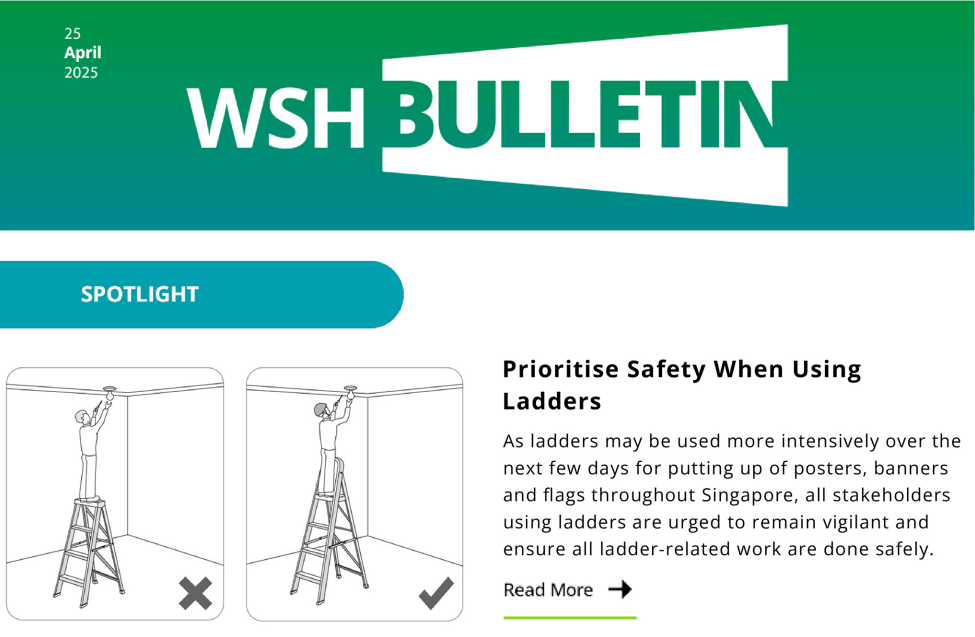
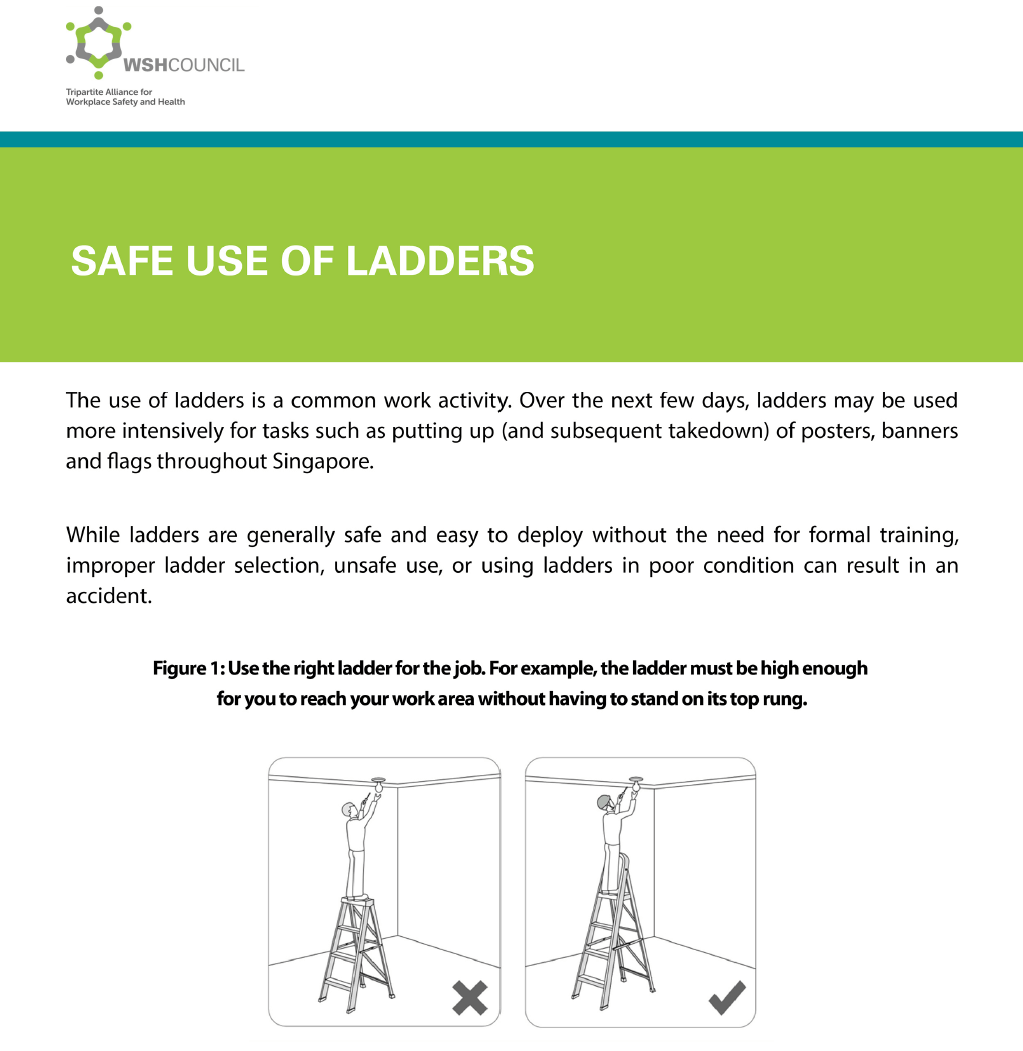
- Standing on the top rung of a ladder
- Using a damaged or unsuitable ladder
- Using an A- frame ladder that is not fully opened and locked
- Setting up ladder near doorways, driveway or near places where a person, vehicle or crane lifted load can hit it
- Positioning a ladder on unstable or uneven ground, causing it to become unstable
Before using ladders, employers should assess the risks and consider:
- Whether the task can be carried out without working at height
- Whether a safer alternative, such as podium steps, a mobile elevating work platform (MEWP) or a scaffold, should be used
- Whether the ladder is suitable for the task and work environment. Ladders should only be used for short-duration tasks (maximum recommended duration: 10 to 15 minutes)
- The ladder’s condition, based on a pre-use inspection
- The height of the work and the duration for which the ladder will be used
- The ground conditions and stability of the ladder
- Nearby hazards, such as doorways, driveways or near places where a person, vehicle or crane lifted load can hit it
Laws and Industry Standards
Employers must comply with Singapore's WSH legislation, including:
- WSH (Work at Heights) Regulations
- WSH (Risk Management) Regulations
- Employers should also refer to relevant industry standards, such as:
- Code of Practice for Working Safely at Heights (English | Mandarin)
- Code of Practice on WSH Risk Management
- Singapore Standard SSEN131:2019 – Ladders
For the full list of approved codes of practice, refer to the WSH (Approved Codes of Practice) Notification.
For more information
- WSH Council Ladder Safety Pack
- SME WSH Pack on Ladder Safety (English | Malay | Tamil | Mandarin)
- Worker’s Safety Handbook for Work at Height (English | Mandarin | Bengali | Tamil)
- GIFs: Maintain a 3-point contact at all times
- GIFs: Check the ladder condition before use
- GIFs: Do not step on the top rung
- WSH Guidelines – Personal Protective Equipment for Work at Height
- Warning Signs Sticker
Resources

25 Apr 2025 Publications Checklists and Articles